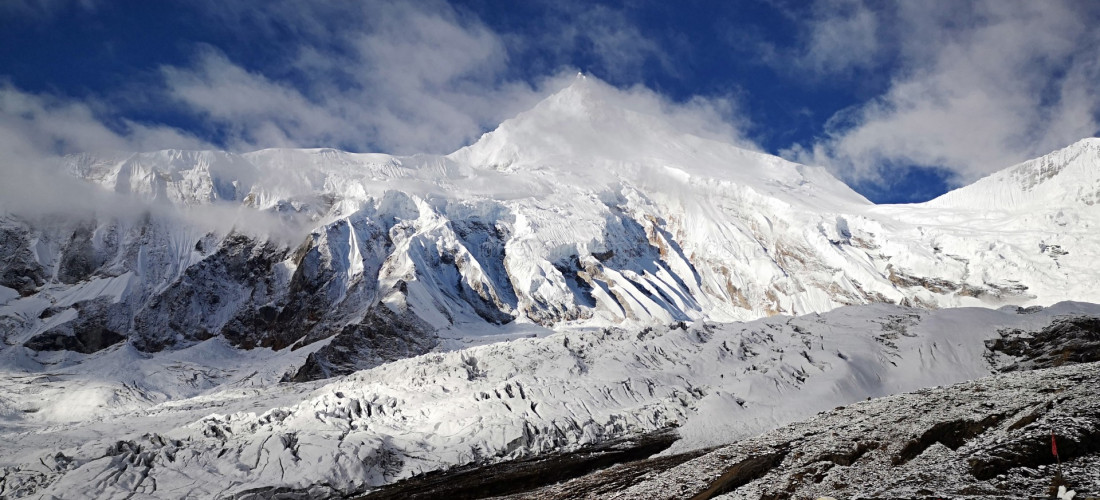
The autumn 2026 Manaslu expedition season ended earlier than many climbers and operators expected. Persistent snowfall, fresh snow on the fixed route, unstable conditions above Camp III and increasing avalanche risk made further summit attempts unsafe. The decision followed a tragic avalanche at Camp III on September 20, in which German national of Indian origin Dhruba Jyoti Guha and Nepali Sherpa guide Phursemba Sherpa lost their lives.
This was not a simple case of a route being unavailable from the beginning. The summit route had reportedly been opened by a rope-fixing team on September 17, after a busy season that attracted roughly 480 climbers in early reports and 493 permit-holding foreign climbers in later Department of Tourism-attributed figures. As the weather deteriorated, however, parts of the route and fixed ropes were covered by new snow and the mountain’s risk profile changed quickly.
This article explains what happened, what is confirmed by reporting available on September 26, and what the 2026 Manaslu season teaches about route assessment, avalanche danger and responsible Himalayan expedition planning.
What Happened on Manaslu in 2026?
Mount Manaslu is 8,163 metres high and is widely recognised as the world’s eighth-highest mountain. It rises in Nepal’s Mansiri Himal and is a demanding high-altitude expedition peak, even when access and weather appear favourable. 5
The 2026 autumn season began with unusually strong interest. Reports cited different counts at different points in September. One early report referred to about 480 climbers, while later Nepal-based reporting, citing Department of Tourism figures, put the total at 493 foreign climbers on 41 teams. An earlier September report had recorded 422 permits. These numbers should not be treated as contradictory without their dates: climbing-permit totals and active summit-attempt figures can change as registrations are updated and as reports use different denominators.
A Nepalese rope-fixing team worked to prepare the Northeast Ridge route. After delays caused by snowfall and avalanche conditions, the team reportedly reached the summit on September 17, opening the route for the season. This was an important operational achievement, but it did not guarantee that the route would remain safe for commercial summit teams.
Soon afterward, persistent and heavy snowfall increased the amount of new snow on the mountain. Sections of the fixed route were reported to have been buried or covered again. Teams above Base Camp faced difficult movement, reduced visibility and growing uncertainty about snow stability.
On the night of September 20, an avalanche struck a tent at Camp III, at approximately 6,800 metres. Dhruba Jyoti Guha and Phursemba Sherpa were later found beneath heavy snow. Their teammates retreated and were reported safe. The deaths became a central factor in the decision by major operators to abandon their summit pushes.
By September 22–24, leading operators had announced cancellations or closure of their commercial Manaslu campaigns. Seven Summit Treks said it had officially closed the season for the safety of everyone on the mountain. Other operators, including 8K Expeditions, Imagine Nepal, Elite Exped, Asian Trekking, Pioneer Adventure and Satori Adventures, were reported to be withdrawing teams and dismantling camps.
Manaslu Expedition 2026: A Promising Start
Route opening is one of the most important early milestones in a Himalayan expedition. Rope-fixing teams establish lines through technical terrain and prepare the route toward the higher camps and summit. In the 2026 season, reports said the team reached Manaslu’s 8,163-metre summit on September 17.
That achievement made the summit route technically accessible. It did not remove objective hazards such as seracs, avalanches, unstable snow, high winds, poor visibility or the need to break trail after a storm.
Heavy Snowfall Changes the Situation
Reports described a rapid change in conditions after the route-opening operation. Snowfall from around September 18–19 covered sections of the route again, while additional snow and wind affected the upper mountain. A separate avalanche delayed or disrupted work around the Camp III and Camp IV area and buried recently fixed sections of rope, according to specialist and Nepal-based reporting.
Weather forecasts also pointed toward further unsettled conditions. Nepal-based reports cited meteorological warnings of additional rain or snowfall affecting the Himalaya around September 24–28. These were forecasts, not a single official avalanche rating for every part of Manaslu, but they added to the risk assessment facing expedition operators.
What Happened at Camp III?
On September 20, an avalanche struck a tent at Manaslu’s Camp III. The tent was reported to be at about 6,800 metres, or approximately 22,000 feet. Dhruba Jyoti Guha, a German national of Indian origin, and Nepali Sherpa guide Phursemba Sherpa were inside.
The two stopped responding to communications. A search by Sherpa rescuers later located them beneath heavy snow. Reports differ slightly on the burial depth and on the spelling of the names, but they agree on the essential facts: both men died in the avalanche, and the other members of their expedition retreated.
Recovery operations were themselves affected by high-altitude conditions and weather. Nepal-based reporting said the bodies were eventually brought down and transported from the Manaslu region to Kathmandu on September 23.
The incident was one of several serious events reported during the 2026 autumn season. Nepal-based sources reported four deaths connected with the season, including the two Camp III fatalities, the death of Singaporean climber Lau Wee Seng during an acclimatisation descent or rotation, and the death of Nepali high-altitude worker Tashi Sherpa at Base Camp earlier in September. The Camp III deaths, however, were the incident most directly connected with the decision to halt the summit campaign.
Why Was the Manaslu Expedition 2026 Called Off?
The Manaslu Expedition 2026 was called off because the combined risk had become unacceptable for continued commercial summit attempts. The decision was not based on one factor alone.
The main concerns reported by operators and climbers included:
• Heavy snowfall: Fresh snow accumulated on the route and high camps, increasing the work required to move safely.
• Unstable snow: New snow and wind loading raised concerns about weak layers and slab formation.
• Avalanche risk: Avalanches affected route preparation, and the Camp III avalanche caused two deaths.
• Difficult movement above Camp III: Higher sections were reported to be buried, exposed or difficult to trail-break.
• Changing forecasts: Further unsettled weather was expected during the remaining summit window.
• Limited flexibility: A late-season storm leaves less time for teams to wait, re-fix ropes and establish safe camps.
• Operator responsibility: Expedition companies have a duty to protect clients, guides, cooks, porters and high-altitude workers, even when climbers are close to a planned summit date.
Seven Summit Treks’ closure announcement was an operator decision rather than a clearly documented blanket government order cancelling every Manaslu permit. Other operators made similar decisions, and reports said most teams were retreating and beginning to close their camps. That distinction is important for accurate reporting.
The 2026 Manaslu Season Ends Without a Summit
Although the route-opening team reportedly reached the summit, the wider commercial expedition season did not proceed to a successful summit push. The Rising Nepal reported that nobody had successfully climbed Manaslu in the 2026 autumn season by the time the season was called off.
For the 2026 teams, the responsible decision was to retreat rather than pursue a summit window through worsening snow and avalanche conditions.
What This Incident Tells Us About High-Altitude Mountaineering
The 2026 Manaslu season offers several important lessons for Himalayan mountaineering.
Mountain weather can change faster than an expedition plan. A route that is prepared in clear weather may be heavily affected by the next storm. Expedition schedules must remain flexible.
Fixed ropes do not eliminate objective hazards. Ropes help climbers move through difficult terrain, but they do not stop avalanches, stabilise snow slopes or make poor visibility safe.
Avalanche danger can increase after heavy snowfall. A new layer can add load to an existing snowpack and hide the signs that teams need to evaluate. The danger can be especially difficult to judge in complex terrain above the higher camps.
The summit goal must remain secondary to safety. A permit, a booked expedition, a fixed route and an approaching weather window do not justify continuing when conditions no longer support a reasonable margin of safety.
Risk assessment must continue throughout the expedition. Professional teams need updated forecasts, route reports, communication between camps, observations from Sherpa staff and the authority to stop a climb. A successful operation on one day cannot substitute for an assessment on the next day.
Is Manaslu Still Safe for Future Expeditions?
It would be inaccurate to describe Manaslu as permanently unsafe, just as it would be inaccurate to call it permanently safe. Mountain conditions vary significantly from one year and season to another.
Climbers should therefore evaluate the specific season rather than rely only on past summit statistics or promotional schedules. A future expedition may be viable if the route is stable and forecasts are favourable. It may also be necessary to delay or abandon the attempt if the mountain does not provide an acceptable risk margin.
Manaslu Expedition vs Manaslu Circuit Trek — Are They the Same?
No. A Manaslu Expedition and the Manaslu Circuit Trek are different travel and mountain experiences.
A Manaslu Expedition involves climbing Mount Manaslu toward the 8,163-metre summit. It requires expedition permits, high-altitude camps, specialised equipment, rope-fixing systems, acclimatisation, technical climbing skills, high-altitude guides and a much higher level of objective risk.
The Manaslu Circuit Trek is a trekking route around the Manaslu region. It does not involve climbing the 8,163-metre summit. Trekkers follow a long-distance trail through mountain villages, valleys and high passes, with different permits, logistics, altitude exposure and safety considerations.
The cancellation of the 2026 climbing expedition therefore does not automatically mean that the Manaslu Circuit Trek is cancelled. Trekking conditions must be checked separately with Nepal authorities and experienced local operators. Weather, landslides, trail damage, accommodation, permits and local access can change independently of high-altitude expedition decisions.
What Should Climbers Consider Before a Future Manaslu Expedition?
Before joining a future Manaslu expedition, climbers should:
1 Check current information from Nepal’s Department of Tourism and other relevant authorities.
2 Ask the expedition operator for recent route, camp and weather updates.
3 Monitor reliable mountain-weather forecasts rather than relying on a single app or old seasonal average.
4 Understand avalanche, altitude illness, cold injury, falls and evacuation risks.
5 Choose an experienced professional expedition team with qualified guides and clear emergency procedures.
6 Follow the decisions of guides and expedition leaders when they advise retreat or cancellation.
7 Make sure insurance and evacuation arrangements match the actual altitude and activity.
8 Remember that a successful route opening is not a guarantee of safe summit conditions.
Amazing Nepal Trek’s Perspective on Responsible Himalayan Travel
As a Nepal-based trekking and expedition company, Amazing Nepal Trek & Expedition believes that responsible mountain tourism begins with respect: respect for the mountain, local communities, guides, porters, high-altitude workers and the families affected by accidents.
We support careful planning, experienced local staff, honest communication about conditions and decisions based on safety rather than summit pressure. In the Himalaya, a responsible expedition is not defined only by reaching the top. It is also defined by the quality of preparation, the care shown to the team and the willingness to turn around when conditions demand it.
Frequently Asked Questions
1. Why was the Manaslu Expedition 2026 cancelled?
Major expedition operators called off their 2026 Manaslu summit attempts because persistent snowfall, unstable snow, buried route sections, avalanche danger and worsening weather forecasts made continued climbing unsafe. The decision followed a fatal avalanche at Camp III on September 20.
2. What happened at Camp III on Manaslu?
An avalanche struck a tent at Camp III on September 20, 2026, at approximately 6,800 metres. German national of Indian origin Dhruba Jyoti Guha and Nepali Sherpa guide Phursemba Sherpa died after the tent was buried by heavy snow.
3. How high is Mount Manaslu?
Mount Manaslu is 8,163 metres high. It is the world’s eighth-highest mountain.
4. How many climbers received permits for Manaslu in 2026?
Reports varied by date. AFP referred to about 480 climbers attempting the mountain, while later Nepal-based reporting citing Department of Tourism figures reported 493 foreign climbers on 41 teams. An earlier report cited 422 permits. The later figures should be used with their source and date rather than merged into one number.
5.Did anyone summit Manaslu in the 2026 autumn season?
The rope-fixing team reportedly reached the summit and opened the route on September 17. However, reports said no expedition team successfully completed a normal commercial summit push before the season was called off.
6. Is Manaslu Expedition different from Manaslu Circuit Trek?
Yes. The expedition is a high-altitude climb toward the 8,163-metre summit. The Manaslu Circuit Trek is a trekking route around the region and does not involve climbing the summit.
7. Does the 2026 expedition cancellation mean Manaslu Circuit Trek is cancelled?
No. Expedition and trekking decisions are separate. Always confirm current trail, permit, weather and access conditions before travelling.
8. Why is snowfall dangerous on Manaslu?
Heavy snowfall can add load to the snowpack, conceal fixed ropes and route markers, make trail-breaking harder and increase avalanche risk. Wind and changing temperatures can make the new snow less stable.
9. When can climbers attempt Manaslu again?
A future attempt depends on the season, permits, route preparation, forecasts, snow stability and professional risk assessment. There is no responsible date that can be guaranteed in advance.
10. What should climbers check before joining a future Manaslu expedition?
They should check official Nepal information, reliable forecasts, route and camp reports, operator experience, evacuation and insurance arrangements, avalanche conditions and the team’s willingness to stop if the mountain becomes unsafe.



 (1) (1).jpg)