If you have ever looked at a map of Nepal and felt your eyes drift away from the obvious trails. Everest, Annapurna. And instead you start staring at the emptier spaces. The corners near Tibet. The hidden valleys behind big ridgelines. The places that feel a little less “on the menu”.
Those areas are usually what Nepal calls restricted areas.
And for years the short answer to “Can I trek there solo?”
was basically… no. Not really. Not in the way most people mean solo.
But now the conversation has changed. There have been
updates and clarifications floating around, and you might have heard something
like “solo trekkers are allowed again” or “new rule says you can go alone”.
So, what is actually true in 2026?
Let’s unpack it cleanly. With the annoying permit details,
the real world logistics, and what “solo” even means once you hit restricted
zones.
First, what counts as a “restricted area” in Nepal?
Nepal has a few different categories that get mixed up
online:
● National
parks and conservation areas (like Sagarmatha, Annapurna, Langtang). These
are not “restricted areas” in the same sense.
● Restricted
areas (special controlled zones near borders or sensitive regions). These
are the ones with extra permits and tighter rules.
● Climbing
peaks and mountaineering regions (different system again).
When people talk about restricted area trekking, they
usually mean places like:
● Upper
Mustang
● Manaslu
region (Manaslu Circuit, Tsum Valley)
● Nar
Phu Valley
● Upper
Dolpo
● Kanchenjunga
(some sections)
● Humla
and other far west border districts
These areas typically require a Restricted Area Permit
(RAP), sometimes plus a conservation permit (ACAP, MCAP, etc), and
sometimes plus other local entries.
And the RAP is where “solo” gets complicated.
Why restricted areas were never truly “solo friendly”
Historically, Nepal’s restricted area system has been built
around a few core ideas:
● Border
security and controlled movement
● Basic
safety and tracking
● Local
economy and regulated tourism
● Administrative
simplicity (one agency handles a group, permits done together)
So the classic rules looked like this in practice:
1. You
must trek via a registered trekking agency.
2. You
must have a licensed guide (or at least official support).
3. RAP
permits were issued for a minimum of two trekkers in many restricted
areas.
That last point is the thing everyone remembers. The “two
person minimum”.
If you were one person, you had to do some workaround. Find
another solo traveler to “pair” with. Or pay for a “ghost trekker” (which is
risky and not something you want to build a trip around). Or just change plans.
So… can you trek solo in restricted areas now?
Here’s the truthful answer:
Yes, in some cases, solo trekking in restricted areas is
possible now, but it still usually requires a registered agency and a licensed
guide.
This is where people get tripped up.
A lot of the “new rules” talk online blends two separate
concepts:
● Solo
as in, you are one traveler (no group).
● Solo
as in, you trek without a guide.
Those are not the same thing in Nepal’s permit world.
In restricted areas, the big shift people care about is
whether one traveler can get permits without needing a second tourist.
In some newly opened or newly clarified cases, the answer has become more
flexible.
But that does not automatically mean Nepal has turned
restricted areas into “fully independent trekking zones” where you just show up
and walk in alone with no support.
For most restricted regions, you should still expect:
● Permit
processing handled by an agency
● A
licensed guide arranged through that agency
● Checkpoints
where they want to see permits and often guide details
So if your dream is “I want to be alone on the trail,
carrying my own bag, no group vibe”, you can often do that.
If your dream is “I want to do Upper Mustang like I do a
weekend hike, with no guide, no agency, and figure it out on the fly”, that is
still not realistic for most restricted areas.
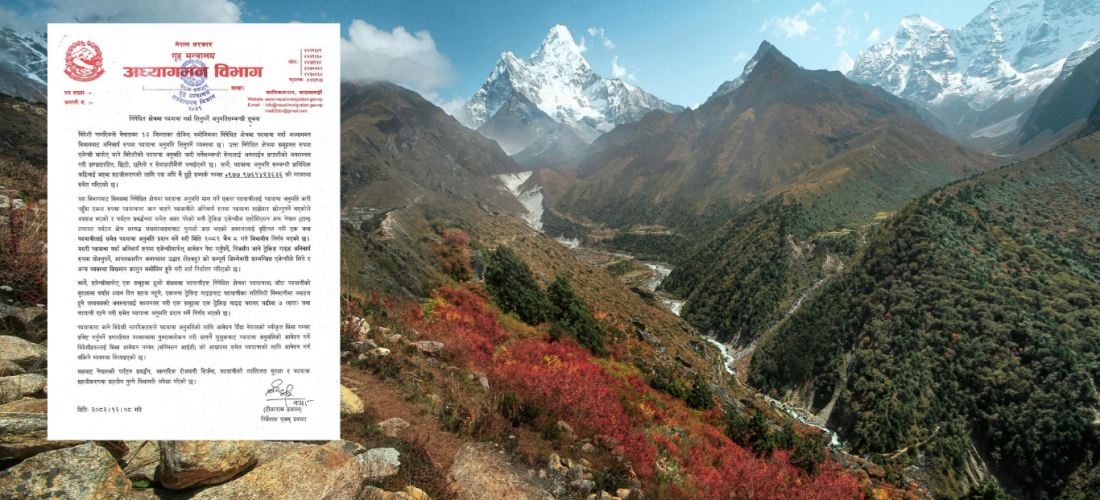
What are the “new rules” people are referring to?
Because Nepal changes procedures, enforces them unevenly,
and sometimes issues updated circulars rather than one big dramatic public
announcement, you’ll see messy information online.
What has shifted in the trekking world recently is mostly
this:
1) More openness to individual trekkers in select restricted
areas
Some regions that were previously treated as “minimum two
trekkers required” have become more workable for a single traveler, depending
on the permit office, the region, and current enforcement.
This doesn’t always show up as a simple “the rule is changed
everywhere forever”. Sometimes it’s more like:
● agencies
can process permits for one person in certain areas
● the
permit office accepts it if documentation is clean
● enforcement
on the trail matches the permit issuance
In other words, it becomes possible. Practically possible.
Which is what most people actually need.
2) A stronger emphasis on proper documentation and
accountability
When solo permits are allowed, the tradeoff is that your
paperwork has to be right. Not “close enough”.
Expect things like:
● exact
itinerary
● entry
and exit points
● passport
details matching permits perfectly
● guide
license details
● agency
stamp and registration
3) Newly opened or re-emphasized “restricted” corridors
Nepal has periodically opened, re-opened, or promoted
certain remote corridors. When that happens, there can be a period where rules
are clarified and adjusted. And travelers interpret that as “new solo policy”.
The important thing is not the rumor. It’s what you can
actually get issued and pass through checkpoints with.
Restricted areas where solo trips are commonly requested (and what to
expect)
Not a legal guarantee here. Just a realistic, traveler
focused view.
Upper Mustang
Upper Mustang is the famous one. It’s restricted, it’s
expensive, and it’s very regulated.
● You’ll
need the RAP for Upper Mustang (plus other applicable permits depending on
route).
● You
should expect to go via an agency.
● “Solo
traveler” trips are often doable if permits can be issued for one, but you
still normally trek with a guide.
Upper Mustang has a lot of checkpoints and a very clear
permit culture. If something is off, it becomes a problem quickly.
Manaslu Circuit and Tsum Valley
Manaslu is restrictive and popular, which means enforcement
is usually serious.
You’ll typically need:
● Manaslu
RAP
● Manaslu
Conservation Area permit (MCAP)
● Often
ACAP depending on the route
Manaslu also has seasonal crowding. Even if you are “solo”,
you will rarely feel fully alone. But you can still do it as one traveler with
your own guide, your own pace.
Nar Phu Valley
Nar Phu feels remote but it’s not a free for all.
● It’s
restricted.
● Permits
and route planning matter.
● A
guide is typically expected.
If you want to do Nar Phu properly, you will also want
someone who can handle the small stuff. Lodges, side trips, weather pivots, and
the odd day where the plan changes because a bridge washed out or a village
festival takes over the only available rooms.
What does “solo” look like on the ground?
This is the part I wish more blogs would say plainly.
A “solo trek” in a restricted area often means:
● You
are the only client.
● You
have a guide with you (and sometimes a porter if you want).
● You
are not in a group package.
● You
control the pacing, stops, side hikes, photography breaks, lazy mornings. All
of it.
That is still a solo travel experience. Honestly, for many
people, it is the best version.
Because restricted areas have real friction:
● permits
● checkpoints
● occasional
language barriers
● reroutes
● altitude
issues in places where rescue is harder
Doing it “solo with support” is not less adventurous. It’s
just less chaotic.
Permits are the main reason you still want an agency, even if you are going
solo
Even with updates allowing solo trekkers in certain
restricted zones, the system is still paperwork heavy.
Restricted Area Permits are not usually something you can
just grab yourself at a counter like a TIMS card used to be.
What tends to be required:
● A
registered Nepali trekking agency to apply on your behalf
● Your
documents (passport copy, photos, visa copy, travel insurance in some cases)
● A
defined itinerary and entry dates
● Payment
in the proper structure (often USD based fee converted and processed)
And then there is the reality that rules are sometimes
enforced differently depending on:
● the
season
● the
checkpoint staff
● political
sensitivities
● the
specific route variant you take
So yes, you can be “solo”. But you still want someone who
can make the permit process boring. Boring is good.
Safety is the other big reason
Restricted areas are not restricted just to be dramatic.
They are remote. Logistics are thin. Communication can be spotty. Weather can
pin you down.
A few things that matter more in restricted areas:
● Acute
Mountain Sickness decisions. When to stop. When to descend. When to push.
● Routefinding
in shoulder seasons. Trails can be vague, landslides happen, snowfall can
erase tracks.
● Lodge
availability. Some villages have very limited beds. If you arrive late, you
might be sleeping in a kitchen.
● Contingency
routes. The “plan B” is not always obvious.
A good local guide is basically your risk management system.
Not in a corny way. In a practical way.
Common misconceptions (the stuff that causes headaches at checkpoints)
“If solo is allowed, I can do it without a guide”
Usually wrong for restricted areas. The permit structure
still tends to be tied to agency issuance and guide accountability.
“I’ll just enter from a side trail and avoid checkpoints”
Bad idea. Also, not that easy. Checkpoints exist where you
least expect them, and if you get flagged without the right permit it can ruin
the whole trip.
“I can figure out permits once I get to the trailhead”
For restricted areas, don’t plan like that. Permits often
need to be processed in Kathmandu (or through agency channels) before you go.
“This blog said the rule changed, so I’m good”
Maybe. Or maybe that blog was written after one traveler had
a lucky experience at one permit desk in one month. You want current, on the
ground confirmation.
Practical advice if you want to trek restricted areas solo
Here’s what I would do if I were planning this right now.
1. Pick
the exact route first. Not just “Manaslu”. Which way, which side trips,
which exit.
2. Ask
a local agency to confirm permit feasibility for one traveler. Not “is it
allowed in theory”. But “can you issue it for me, for these dates”.
3. Build
extra days into the itinerary. Restricted areas punish tight schedules.
4. Get
proper insurance that covers trekking altitude and emergency evacuation.
Read the fine print.
5. Treat
the guide as part of the plan, not an obstacle. If you want quiet, say you
want quiet. If you want to walk ahead alone sometimes, ask what is safe and
acceptable.
Where Amazing Nepal Trek fits in (and why it matters more for restricted
zones)
This is the part people underestimate when they plan remote
Nepal.
In restricted areas, the “hard part” is not always the
walking. It’s the system around the walk.
That is why a solid local partner matters, and why Amazing
Nepal Trek keeps coming up for treks like Upper Mustang, Manaslu, and
Nar Phu Valley.
They are not just selling a generic package. They are doing
the unglamorous work that makes the trip smooth:
● confirming
what is currently possible for solo travelers in your chosen restricted area
● handling
permit processing properly, with the correct itinerary and documentation
● matching
you with an experienced guide who actually knows the region, not someone who is
guessing day to day
● helping
with logistics that you only notice when they go wrong. Transport timing, lodge
strategy, contingency planning
And if you are solo, this stuff becomes even more important.
Because you don’t have a group buffer. If one thing breaks, it is just you
dealing with it.
Even with the latest updates that can allow solo trekkers in
restricted areas, you still want the balance: freedom, but not friction.
Adventure, but not paperwork stress.
So what’s the real takeaway?
Yes, solo trekking in Nepal’s restricted areas can be
possible under the newer, more flexible interpretations and updates,
especially in certain newly opened or clarified contexts.
But for most restricted regions, “solo” still tends to mean:
● one
traveler
● permits
handled through a registered agency
● trekking
with a licensed guide (and optionally a porter)
If that is acceptable to you, great. You can still have a
deeply independent feeling trek. You set the pace. You choose the photos stops.
You get the quiet.
And if you want to do it with less guesswork, reach out to a
local specialist like Amazing Nepal Trek who already works in these
regions and can tell you, plainly, what is currently doable for your exact
route and dates.
Because in Nepal restricted areas, the difference between a
dream trek and a permit problem is usually just… details. And timing. And
having the right people handle it.
FAQs (Frequently Asked Questions)
What are 'restricted areas' in Nepal trekking, and how do they differ from
national parks?
Restricted areas in Nepal are special controlled zones near
borders or sensitive regions that require extra permits and tighter rules.
Unlike national parks and conservation areas like Sagarmatha or Annapurna,
restricted areas include regions such as Upper Mustang, Manaslu, Nar Phu
Valley, Upper Dolpo, Kanchenjunga sections, and Humla. These areas typically
demand a Restricted Area Permit (RAP) along with other possible permits.
Can I trek solo in Nepal's restricted areas in 2026?
Yes, solo trekking in some restricted areas is possible now
but usually still requires going through a registered trekking agency and
having a licensed guide. While you can be the only traveler (no group),
trekking without a guide or agency support is generally not allowed. The key
change is that one traveler can obtain permits without needing a second
tourist.
What does 'solo trekking' mean in the context of Nepal's restricted areas?
In Nepal's restricted zones, 'solo trekking' can mean either
traveling alone without others or trekking without a guide. However, these are
different: most new rules allow solo travelers (one person) to get permits but
still require a licensed guide arranged by an agency. Independent trekking
without guides remains largely prohibited in these zones.
Why were restricted areas traditionally not 'solo friendly' for trekkers?
Historically, Nepal's restricted area policies focused on
border security, safety tracking, supporting local economies through regulated
tourism, and administrative simplicity. This meant permits were often issued
only for groups of two or more trekkers with licensed guides via registered
agencies. Solo trekkers had to find workarounds like pairing with others or
paying for fictitious companions.
What are the recent changes or 'new rules' regarding solo trekking in
Nepal's restricted zones?
Recent updates have made it more feasible for individual
trekkers to obtain Restricted Area Permits without requiring a minimum of two
people. Agencies can now process single-person permits in certain regions if
documentation is precise and enforcement aligns with permit issuance. There's
also increased emphasis on exact itineraries, matching passport details, guide
licenses, and agency registrations.
What should I expect logistically if I plan to trek solo in Nepal's
restricted areas?
You should expect to work with a registered trekking agency
that handles your permit processing and arranges a licensed guide. Checkpoints
will verify your permits and guide details during the trek. Although you may
hike alone carrying your own gear without a group vibe, fully independent
trekking without agency or guide support is generally not permitted in these
sensitive regions.

 (1) (1).jpg)